Кәсепсе Оптик трансивер модульдәре глобаль мәғлүмәт үҙәктәре һәм селтәрҙәр өсөн.


100GBASE-SR4 vs. 100G AOC: селтәрегеҙ өсөн кәрәкле ҡыҫҡа аралы 100G тоташтырыуҙы һайлау #18
Mar 03,2026
In today’s data centers, short-range interconnect technologies handle massive data transfers between servers, storage devices, and switches. As cloud, big data, and AI grow, 100G networks are becoming a key part of how we conduct high-performance operations. Their main goal is to deliver enough bandwidth, low latency, and stable links, providing reliable support for real-time computing and compute-intensive workloads.
In such short-reach interconnect scenarios, 100G SR4 optical modules and 100G QSFP28 AOCs (Active Optical Cables) are currently the two most widely adopted solutions. Both achieve 100 Gbps speeds, but their differing technical architectures result in distinct performance, deployment flexibility, cabling methods, and overall cost characteristics. This article provides an analysis of these two interconnected solutions based on actual data center operational requirements.
QSFP28 SR4 and AOC Product Overview and Technical Specifications
100G SR4 Optical Module
The 100G SR4 optical module is a high-speed module based on the QSFP28 form factor. It achieves an impressive total transmission rate of 103.125 Gbps through 4×25.78 Gbps parallel optical channels. It uses OM3 or OM4 multimode fiber for short-distance links, supporting up to 70 meters on OM3 and 100 meters on OM4. This makes it ideal for high-bandwidth connections in data centers. The module has a 12-fiber MPO/MTP interface, and the fiber patch cords and modules can be replaced separately, making it easy to make cabling adjustments or upgrade links later on. It typically consumes less than 2.5 watts, meeting the IEEE 802.3bm 100GBASE-SR4 specifications and the relevant QSFP28 MSA standards. Typical applications include ToR and EoR switch interconnections, high-speed storage system interfaces, and latency-sensitive scenarios such as HPC cluster node communications.

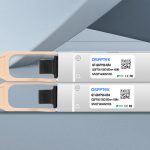
QSFPTEK 100GBASE-SR4 Module
100G QSFP28 AOC (Active Optical Cable)
The 100G QSFP28 AOC integrates an optical transceiver with multimode fiber into a fixed, all-in-one link. It undergoes factory-completed electro-optical conversion, signal calibration, and comprehensive performance testing. Featuring QSFP28 interfaces at both ends, the fiber section is factory-terminated and sealed with integrated amplification and equalization circuits, enabling direct plug-and-play operation.
AOC offers many advantages. It eliminates the need for separate patch cords and fiber insertion/removal. It resists dust and contamination. It minimizes performance fluctuations caused by insertion loss. It typically consumes less than 3.5 watts of power and can transmit data at up to 100 meters, which is enough to meet most high-speed connectivity needs between racks and devices. Designed to comply with IEEE 802.3bm and SFF-8665 specifications, AOCs are compatible with mainstream switch and server interfaces while supporting both 100GbE and InfiniBand EDR networking environments.

QSFPTEK 100G AOC Cable
They are commonly deployed for high-speed inter-rack connectivity, large-scale fixed-length cabling, and high-density deployment environments.
| 100G SR4 | 100G QSFP28 AOC | |
| Media | OM3/OM4 MMF | Integrated MMF |
| Distance | OM3: ≤70m, OM4: ≤100m | ≤100m |
| Connector | MPO/MTP-12 fiber | Fixed QSFP28 |
| Module-Fiber Separation | Yes (independent upgrade) | No (integrated solution) |
| Deployment Flexibility | High (flexible patch cords) | Medium (fixed length) |
| Power Consumption | ≤2.5W | <3.5W |
| Compliance | IEEE 802.3bm, QSFP28 MSA, SFF-8665, SFF-8636 | IEEE 802.3bm, SFF-8665 |
QSFP28 SR4 and AOC Product Overview and Technical Specifications
100G SR4 Optical Module
The 100G SR4 optical module is a high-speed module based on the QSFP28 form factor. It achieves an impressive total transmission rate of 103.125 Gbps through 4×25.78 Gbps parallel optical channels. It uses OM3 or OM4 multimode fiber for short-distance links, supporting up to 70 meters on OM3 and 100 meters on OM4. This makes it ideal for high-bandwidth connections in data centers. The module has a 12-fiber MPO/MTP interface, and the fiber patch cords and modules can be replaced separately, making it easy to make cabling adjustments or upgrade links later on. It typically consumes less than 2.5 watts, meeting the IEEE 802.3bm 100GBASE-SR4 specifications and the relevant QSFP28 MSA standards. Typical applications include ToR and EoR switch interconnections, high-speed storage system interfaces, and latency-sensitive scenarios such as HPC cluster node communications.
100G QSFP28 AOC (Active Optical Cable)
The 100G QSFP28 AOC integrates an optical transceiver with multimode fiber into a fixed, all-in-one link. It undergoes factory-completed electro-optical conversion, signal calibration, and comprehensive performance testing. Featuring QSFP28 interfaces at both ends, the fiber section is factory-terminated and sealed with integrated amplification and equalization circuits, enabling direct plug-and-play operation.
AOC offers many advantages. It eliminates the need for separate patch cords and fiber insertion/removal. It resists dust and contamination. It minimizes performance fluctuations caused by insertion loss. It typically consumes less than 2.2 watts of power and can transmit data at up to 100 meters, which is enough to meet most high-speed connectivity needs between racks and devices. Designed to comply with IEEE 802.3bm and SFF-8665 specifications, AOCs are compatible with mainstream switch and server interfaces while supporting both 100GbE and InfiniBand EDR networking environments.
They are commonly deployed for high-speed inter-rack connectivity, large-scale fixed-length cabling, and high-density deployment environments.
Comparing 100GBASE-SR4 vs. 100G AOC Bandwidth, Latency, and Stability Performance
After explaining the main features of these two short-distance connection options, checking their performance in terms of bandwidth, delay, and stability helps data centers make better choices when setting up 100G networks. Both SR4 modules and AOCs use a 4x25Gbps parallel channel architecture to deliver full 100Gbps throughput. SR4 typically performs best with OM4 fiber, making it suitable for links between switches and high-performance servers that handle a lot of data quickly. AOC ensures the bandwidth remains constant, regardless of cable length. This is especially helpful for networks with fixed structures and extensive cabling.
While the two have almost the same latency, there is only a difference in some situations. SR4 has a shorter signal path and simpler processing chain, which makes it better at sending signals quickly. SR4 is more suitable for rapid signal transmission environment, such as high-performance computing, real-time analytics, and financial transactions. Using higher-quality fiber can improve connectivity. AOCs exhibit slightly higher latency, typically in the picosecond range. This impact is pretty small for services like cloud storage or virtualization that don’t really care about how long it takes. Their internal active driver circuitry helps make sure that links are always available.
When it comes to stability, each product type has its own preferences. SR4 performance depends on the quality of the module, fiber, and connector. If the fiber end-face is unclean or control is poor, it may lead to increased bit-error rates. However, SR4 supports digital monitoring, allowing you to track power and temperature in real time. Under professional operation and maintenance conditions, it can maintain extremely high stability. AOCs, on the other hand, eliminate installation-related insertion loss variations or contamination issues through pre-packaging and factory calibration. Their entire link consistently performs well, making them more stable in situations where they need to be set up quickly, used in large construction projects, or maintained often.
Application-Oriented Comparison
Comparing 100GBASE-SR4 modules and 100G QSFP28 AOCs based on practical application requirements clearly shows their differences across various scenarios. In situations where delay is a problem, such as in financial trading systems, high-performance computing clusters, or AI training networks, 100G SR4 is often the better choice. Its lower link latency and support for upgrading to higher-quality multimode fiber as needed ensure sustained performance advantages over time, making it suitable for architectures requiring rapid response and continuous optimization.
Conversely, in scenarios demanding rapid deployment of numerous 100G connections within a short timeframe, the advantages of 100G QSFP28 AOC become more pronounced. As factory-terminated integrated cables, AOCs significantly reduce manual intervention during installation, lowering contamination and assembly error risks while effectively shortening delivery cycles for large-scale deployments.
In data centers prioritizing future scalability, 100G SR4 remains dominant. Its separable module and fiber design allows operations teams to upgrade link components incrementally, maintaining high flexibility as network traffic gradually increases.
Conversely, for organizations with limited workforces, smaller operations teams, or a greater emphasis on operational stability, 100G QSFP28 AOCs offer a relatively hassle-free solution. AOC is easy to plug-and-play, reducing the risk of human error. This is especially helpful in places with few staff members or where staff lack specialized training to care for the fiber.
Cost-Benefit Analysis
After comparing bandwidth, latency, and stability, examining the differences between SR4 modules and AOC from a cost and operational perspective helps determine their overall value for real-world use.
SR4 modules require separate multimode fiber and cost a bit more at first, especially in large-scale networks with many short connections. AOCs, which have a built-in cable structure, typically have more stable, predictable costs. In scenarios with short rack-to-rack distances, their total investment is often lower than the combined solution of SR4 modules plus fiber.
The combination of SR4 modules and fiber optic solutions supports the replacement of damaged modules or fibers individually, offering a better flexibility for network upgrades or localized troubleshooting. In the long-term operation, SR4 is more cost-effective and allows the reuse of existing cable systems. When an AOC link fails, the entire cable and its two connectors must be replaced, leading to increased maintenance costs. However, the single-point replacement operation is more straightforward and reduces labor requirements.
When it comes to flexibility and adjustability, the two solutions have different strengths. SR4 is better for data centers that need frequent upgrades, adjustments, or expansions. AOC is better for one-time, bulk, and high-efficiency network deployments.
Comprehensive Conclusion
In short-reach interconnect scenarios, 100G SR4 modules and 100G QSFP28 AOC cables are two standard solutions: “Flexible scalability” versus “efficient deployability.” SR4 modules are great because you can easily upgrade them, they’re quick, and they can handle network changes as they occur. They are perfect for situations where heavy computing is required, for connections between switching layers, and for data centers that need to grow or change frequently. AOCs, with their built-in cable design, are very stable and easy to maintain in short links. For scenarios emphasizing rapid deployment, reduced operational risks, or bulk installations within established topologies, AOC often delivers a more cost-effective overall experience.
Therefore, network planners should evaluate flexibility, performance requirements, and long-term operational costs along with their business models, budget cycles, existing cabling infrastructure, and future expansion plans to select the most suitable short-distance connectivity solution. QSFPTEK offers a wide range of products, including 100G SR4 and QSFP28 AOCs. All devices are thoroughly tested to ensure reliability and performance. Experts also support them to help data centers set them up quickly, make sure they work well, and grow as needed
PREVIOUS:
Related Posts
Беҙҙең менән элемтәгә керегеҙ
E-mail :
nily@byfastener.com
WhatsApp:
+8618132303765
Address:
Yulin Industrial Zone, Liuying Township, Yongnian District, Handan City, Hebei Province, China